
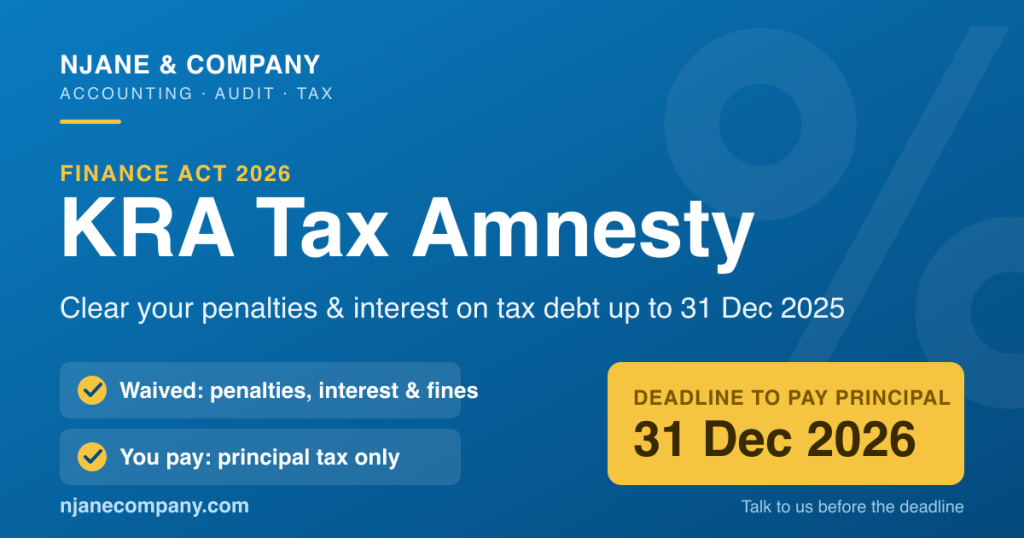
If you have old tax debt, 2026 is the year to fix it. On 1 July 2026, the Finance Act, 2026 started a tax amnesty. It helps taxpayers clear records with the Kenya Revenue Authority (KRA).
The idea is simple, and genuinely good news: pay the actual tax you owe, and KRA will wipe out the penalties, interest and non-compliance fines that have piled on top of it. No drawn-out negotiations, no begging for mercy, no expensive appeals. Just the principal, paid on time, and a clean slate.
There is a deadline and strict rules. Njane & Company explains the amnesty in this guide. We show what it covers, how it works, and what you must do.
What the 2026 tax amnesty actually is
A tax amnesty is a limited-time offer from the government. You pay the real tax you owe. The state forgives the punitive charges, late-payment penalties, interest and non-compliance fines.
Kenya has had amnesty programs before. Often, KRA records show much more debt in penalties than in actual tax. Taxpayers think the debt is too large and pay nothing. This stops them from clearing the balance.
The 2026 amnesty, from the Finance Act, 2026, stops this problem. It removes penalties and interest so you can pay the tax. This helps KRA collect money and helps you reset your accounts.
What exactly gets waived
Under the amnesty, KRA will delete three things from qualifying tax liabilities:
- Penaltiesthe fixed or percentage-based charges applied for paying late or filing late.
- Interestthe amount that accrues month after month on unpaid tax, often the single largest part of an old debt.
- Non-compliance finescharges tied to failures such as not filing returns on time.
What you still have to pay is the principal, the actual tax that was due in the first place. Think of the principal as the real bill, and the penalties and interest as the late-payment surcharges. The amnesty forgives the surcharges once you clear the real bill.
What period does it cover?
The amnesty applies to tax liabilities that happened on or before 31 December 2025. It includes the tax, the penalties and the interest.
This covers many tax types. It includes corporate tax, VAT, PAYE and withholding tax. If you owe it from on or before 31 December 2025, it is in the program.
The one condition: clear the principal before 1 January 2027
Here is the part you cannot afford to get wrong. To benefit from the amnesty, you must pay the full principal tax before 1 January 2027, that is, on or before 31 December 2026.
Pay the principal in time, and the waiver applies. Miss the deadline, and the penalties and interest snap back into place as if the amnesty never existed. There is no partial credit for good intentions; the qualifying event is the principal being settled in full within the window.
The good news is that the waiver is largely automatic. In most cases you do not need to file a separate application begging KRA to remove the interest and penalties. Once your principal for a qualifying period is paid in full, KRA’s system recognises it and writes off the associated penalties and interest against that liability. Your job is to make sure the principal is correctly identified and correctly paid; the system does the erasing.
A worked example: how the numbers play out
Numbers make this concrete. Consider a simple, realistic scenario.
Say your actual tax bill for 2020 was Ksh 100,000. At the time, cash flow was tight, business was slow, and paying the taxman was not the priority, so the bill went unpaid.
Over the years since, penalties and interest have quietly accumulated on that unpaid amount. By 2026, they add up to, say, Ksh 30,000. On paper, KRA now shows you owing Ksh 130,000.
Under the amnesty, if you pay the Ksh 100,000 principal before 2027, KRA takes the rubber and erases the Ksh 30,000 in penalties and interest. You settle the real tax, and the surcharge disappears. You have cleared a Ksh 130,000 headache for Ksh 100,000, and you walk into 2027 with that liability fully closed.
Now scale that up. A business with several years of accumulated balances might be staring at a KRA ledger where penalties and interest are 30, 40, even 50 percent of the total shown. On a large old debt, the amnesty can translate into hundreds of thousands of shillings, or more, simply forgiven. That is money that stays in your business.
Which taxes are covered?
The amnesty is broad and covers most of the taxes Kenyan businesses and individuals deal with, including:
- Pay As You Earn (PAYE)tax on employee salaries.
- Value Added Tax (VAT)the consumption tax charged on sales.
- Corporation Taxtax on company profits.
- Withholding Tax (WHT)tax withheld on certain payments.
- Capital Gains Tax (CGT)tax on gains from the sale of property and certain assets.
- Excise Dutyduty on specific goods and services.
- Monthly Rental Income Taxtax on residential rental income.
- Turnover Tax (TOT)the simplified tax for small businesses.
- Digital Service Tax and Significant Economic Presence Taxtaxes tied to the digital economy.
Do not guess if your balance qualifies. Contact us to check your iTax ledger. It is safer to confirm your account status.
The question everyone is asking: what about late filing of the 2025 return?
One question keeps coming up, and it is a good one: “Will KRA also waive the penalties for filing my 2025 tax return late?”
The answer is yes. Because the liability relates to a period on or before 31 December 2025, the late-filing penalties tied to your 2025 return fall within the amnesty. If you file that return and settle any principal tax due on it before the deadline, the associated penalties for filing late are covered.
Many taxpayers have flat penalties for late filing or no filing. The amnesty helps you regularize your history. You can clear those penalties even if you have no principal tax.
What you should do now: a simple action plan
The amnesty is generous, but it rewards action, not intention. Here is the sequence to follow.
1. Check your iTax ledger immediately
Log in to iTax. Get your statement of account for each tax obligation. This includes PAYE, VAT, and income tax. Your ledger shows the amount KRA thinks you owe. It shows the principal, the penalties, and the interest. Look at your ledger to plan your payments. Many taxpayers find the ledger data unexpected.
2. Identify the principal tax outstanding
Separate the real tax (the principal) from the penalties and interest. This is the single most important step, because the amnesty is triggered by clearing the principal, and only the principal. Getting this figure right, and making sure the ledger itself is accurate, is where professional help pays for itself. Ledgers can contain errors: misallocated payments, duplicated assessments, returns filed but not captured. You do not want to pay a “principal” that is overstated because of a mistake on KRA’s side.
3. Pay the principal tax before the deadline
Generate a payment registration number (PRN) for the principal and pay it before 1 January 2027. Make sure each payment is applied to the correct tax head and period, so that it actually clears the qualifying principal rather than sitting unallocated or landing against the wrong obligation.
4. Leave the penalties, interest and fines untouched
This is the part that feels counter-intuitive: do not try to pay the penalties, interest and fines. Leave them exactly where they are. Once the principal is settled, KRA will erase them under the amnesty. Paying them yourself would simply be throwing away money the state is offering to forgive.
Cannot pay the full principal at once? Consider a payment plan
For some taxpayers, especially businesses with large accumulated balances, finding the full principal in one payment is a real challenge. The amnesty still works for you, but you need to plan.
You can approach KRA for a payment plan that spreads the principal over the period leading up to 31 December 2026. KRA has historically been willing to agree structured instalment arrangements for material debts on a case-by-case basis. The key is to start the conversation early, the closer you get to the deadline, the less room there is to spread payments and still finish in time. Structuring the plan properly, and ensuring every instalment is allocated to principal, is essential; a well-designed plan keeps you on track to clear the principal within the window and secure the waiver.
Common mistakes to avoid
Because the rules are precise, small errors can cost you the waiver. Watch out for these:
- Waiting until December. Reconciling your ledger, correcting returns and arranging payment all take time, and KRA is busiest at the deadline. Procrastination is the number one way people miss out.
- Paying the wrong amount. Overpaying because the ledger is wrong, or underpaying because you missed a liability, both cause problems. Confirm the true principal first.
- Misallocating payments. A payment applied to the wrong tax head or period may not clear the qualifying principal, and the waiver may not trigger.
- Paying the penalties. Remember, the penalties and interest are meant to be erased. Do not pay them.
- Ignoring unfiled returns. If returns are outstanding, filing them may be a prerequisite to establishing and clearing the principal. Sort your filing history as part of the exercise.
Who stands to gain the most
The amnesty is broad, but a few groups have especially strong reasons to act.
Small and medium businesses carrying legacy balances. Many Kenyan SMEs have an old VAT or PAYE balance from a tough trading year that has been quietly compounding. For these businesses, the interest alone can rival the original tax. Clearing the principal now converts a scary, ever-growing number into a fixed, manageable one, and then erases the scary part.
Landlords and rental income earners. Monthly Rental Income Tax is often under-declared in Kenya. Use the amnesty to fix your records if you did not declare your residential rental income before 2025. Declare the income. Pay the principal. KRA will remove the penalties.
Directors and individuals with unfiled returns. If you have missed filing individual income tax returns, the flat late-filing penalties add up fast even when little or no tax is due. The amnesty lets you bring your filing history current and clear those penalties in one exercise.
Companies preparing for growth, financing or tenders. A clean KRA record and a valid Tax Compliance Certificate are prerequisites for government tenders, bank financing and many corporate contracts. Using the amnesty to close old liabilities removes a hidden obstacle to your next opportunity.
Why you should act now, not later
It is tempting to file this under “things to deal with before December”. Resist that temptation, for several reasons.
First, the deadline is fixed. You must pay the principal before 1 January 2027. Do not expect an extension. It is a risk to rely on one.
Second, the groundwork takes time. Pulling ledgers, reconciling accounts, correcting misfiled returns, quantifying the true principal, and, if needed, negotiating a payment plan, none of this happens overnight, especially if several years and multiple tax heads are involved.
Third, KRA gets busy. As the deadline approaches, systems slow down and support queues lengthen. The taxpayers who move early get their reconciliations, PRNs and payment plans sorted while there is still breathing room.
Fourth, the upside is immediate and permanent. Clearing an old liability under the amnesty does not just save you the penalties and interest today; it removes a recurring source of stress, keeps you compliant, protects your Tax Compliance Certificate, and puts your business on solid footing for tenders, financing and growth.
How Njane & Company can help
Njane & Company helps you get the full benefit of the amnesty. We reduce your risk. We understand how KRA systems work. We help you avoid mistakes.
- Pull and reconcile your iTax ledger across every tax obligation, so you see the complete, accurate picture of what you owe.
- Establish the true principal due for each qualifying period, and challenge any errors, misallocations or duplicated assessments on the ledger.
- Quantify your savings, showing exactly how much in penalties and interest the amnesty will erase for you.
- Bring your filing up to date, including any outstanding or late 2025 returns, so nothing blocks the waiver.
- Generate and correctly allocate payments so you pay the principal and get the waiver.
- Negotiate and structure a payment plan with KRA where paying in one go is not practical.
- Confirm the waiver has been applied after you pay the principal. We will provide documentation for your records.
Whether you are an individual with a few years of unfiled returns or a company sitting on a large accumulated balance, the process is the same: look at the ledger, find the principal, pay it correctly, and let KRA erase the rest. We make sure each of those steps is done right.
Frequently asked questions
Do I have to apply for the waiver?
The waiver is usually automatic after you pay the principal. KRA will remove the penalties and interest. Your ledger must be correct. Your payments must be allocated correctly for this to happen.
What if I only pay part of the principal?
The waiver applies if you pay the principal in full within the time limit. If you cannot pay all of it now, talk to KRA about a plan. You must pay the full principal before 1 January 2027.
Does the amnesty cover tax periods after 2025?
No. It covers liabilities that arose on or before 31 December 2025. Keep your 2026 obligations current and separate from your amnesty planning.
I have penalties but no principal, do I benefit?
Yes. You can clear flat penalties for late or non-filing for periods up to 31 December 2025. Use the amnesty to clear these penalties even if you owe a small amount or no principal.
Will this affect my Tax Compliance Certificate?
Clearing old liabilities and regularising your filings generally improves your compliance status, which supports your ability to obtain and maintain a Tax Compliance Certificate, essential for tenders, contracts and many financing applications.
What if my ledger shows amounts I dispute?
A ledger can show balances with which you do not agree. For example, a missing payment or an estimated assessment. You must resolve these issues before you pay. This makes sure you pay the correct principal amount. A professional review helps you.
Is there any risk in coming forward?
The amnesty is designed to encourage taxpayers to regularise their affairs, not to punish those who do. Settling your principal and getting current is the compliant, low-risk path. Continuing to ignore old debt, by contrast, leaves penalties and interest growing and exposes you to enforcement once the amnesty window closes.
The bottom line
The 2026 tax amnesty is a rare opportunity to remove old penalties, interest, and fines. Pay the tax you owe. The rules cover liabilities up to 31 December 2025. Pay the principal before 1 January 2027. The system removes penalties and interest when you pay the principal.
The businesses and individuals who benefit most will be the ones who move early, get their ledgers right, and pay the correct principal on time. The ones who lose out will be those who wait until December and run out of runway.
Do not leave money on the table. Check your iTax ledger, identify your principal, and let us help you clear it, and your penalties, cleanly before the deadline. Talk to Njane & Company today, and walk into 2027 with a clean slate.
This article is general information, not tax advice. The terms, coverage and deadlines of the amnesty are set by the Finance Act, 2026 and administered by KRA. Please confirm your specific position with Njane & Company or with KRA before acting.